
Madness: Expecting Change While Refusing to Change

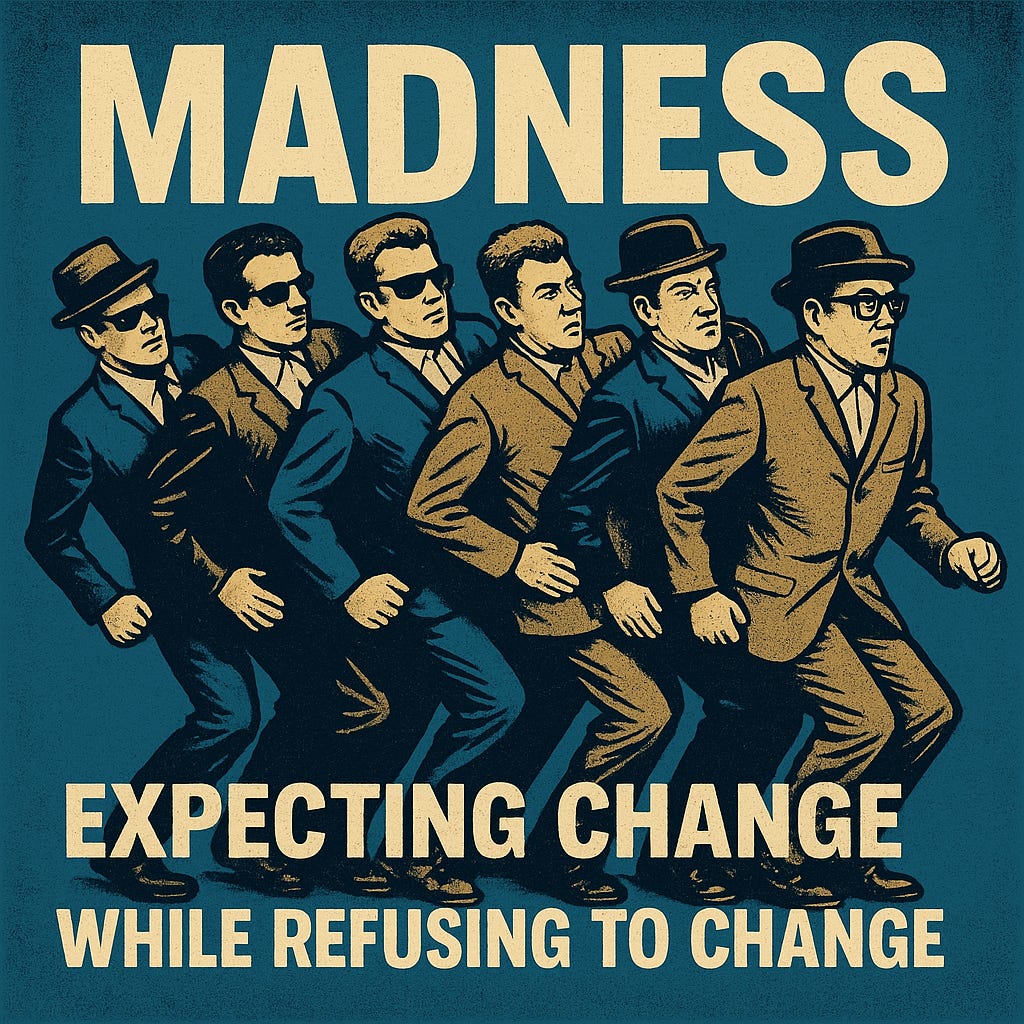
“Expecting different outcomes while repeating the same playbook is a path to frustration — it’s the definition of madness.”
We talk about transformation in sport, we sit at conferences, we hire agencies—and yet, the foundational architecture of European sports largely remains intact. We expect change. But we refuse to change.
The 1992 Blueprint Still Binds Us
The Premier League’s inception in 1992 wasn’t just a rebrand—it rewrote how football was packaged, distributed, and monetised. It created a template: centralised rights, club-as-brand, media as king. Over thirty years later, we have mastered optimization: better data (when we capture it), smarter fan apps, refined pricing. But we haven’t upended the logic underneath.
We apply technology to the existing model, not to question its relevance. We layer dashboards, CRM Systems, content engines—yet we seldom ask, should this be our frame at all? We would rather ask when AI will change our business - knowing we don’t have the data to feed an AI, and in reality see it as a new opportunity to entice cash rich AI companies to spend on classic sponsorship.
At the Portugal Football Summit, voices challenged that inertia:
Sascha Schmidt, author of Diversify or Die, warned that many clubs cling to “monolithic revenue streams” even as audiences fragment and opportunity multiplies.
Alban Dechelotte, CEO of G2 Sports, urged the shift to ecosystem metrics—building something beyond the old school, otherwise ‘esports wins’ as the classic sports audiences ages out.
Luis Vicente spoke elegantly about the “democratisation of sport,” calling for structures where fans are not passive consumers, but participants.
These voices remind us that the urgency isn’t just incremental growth—it’s rethinking the pillars.
The Clone Trap: When Everyone Uses the Same Playbook
Here’s a dirty secret: when every club hires the same consultants, consumes the same benchmark reports, and builds identical “fan dashboards,” you get a league of clones. That is the risk of “safe strategy.”
The old logic holds: “no one gets fired for picking IBM (or the safe consultant).” But when the system is designed for safety, you lose distinction. And in sports, distinction is everything. It’s why I enjoy watching what Bia Sports or Club Brugge are attempting…its not banal.
Data dashboards and benchmarking have become crutches. You can produce twenty clubs with identical engagement analytics—and none with unique insight. You may measure everything but miss the needle: what your fans feel, not what they do.
Ben Wells, CEO of PTI Digital, has been honest in his recent reports: many rights holders are overextended, shackled by fixed costs and limited revenue diversification. When margins shrink, the model unravels. The C-Suite believe in tech, but cling to Sponsorship and Media Rights as their saviours - as self reported!
And Altman Solon’s Global Sports Survey continually underscores structural fragility: margin pressure, media fragmentation, intensifying competition for eyeballs. (Altman Solon)
Risk isn’t in optimization alone—it’s in optimizing the wrong core.
Benfica’s Loyalty Reboot: Starting at Ground Zero
Benfica’s approach, as shared by Hugo Felipe Freitas, is a case in point. Their loyalty system is not a “points in stadiums” add-on; it is a redesign from first principles: How can the club improve fans’ lives every day? Not just at matchday.
That mindset is radical. It requires rejecting assumptions like “fans are passive broadcasters” and embracing the notion of the club as a companion, a co-creator. The ambition is relational, not transactional. That is despite the fact that their learnings about the fans come from being able to understand their daily transactions.
By embedding itself into the day to day live of its fans it builds a true picture of who they are, where they are and where they spend their time. Of course there is the football element but the way Benfica have added value into the routine of our everyday lives means they may be one of the few clubs around that could actually use AI to take the next steps.
When you rebuild at the root, you free yourself from the straitjacket of legacy revenue and turn your lens to what fans truly want—meaning, recognition, agency, stories, and above all - community and belonging.
Women’s Sport: A Breakout Opportunity
If there’s a sector primed for structural reinvention, it’s women’s sport. Less burdened by legacy costs, less constrained by institutional inertia, it offers room to build from first principles.
One recurring message at the Summit was simple: women’s sport should not be forced to measure success by men’s metrics. It must define its own success.
The Wasserman Collective reports that 72 % of women globally now identify as avid fans of at least one sport, underscoring fandom growth. (Wasserman)
Their study also shows women are more likely than men to notice brand involvement, engage in content, and make purchases tied to team or sponsor integration. (Wasserman)
Additional Wasserman research highlights that women’s sports now account for about 15 % of total sports media coverage—far beyond the old “4 % myth”—a sign that the narrative is shifting. (Wasserman)
In The Collective Economy Part II, it’s noted that 66 % of women sports fans believe organisations don’t understand or appeal to them—revealing a gap that can be a launchpad for difference. (Wasserman)
That point is key - and my hope is that Women’s sports don’t hire the same consultants who have been entrenched in Men’s sports for so long. Its not that they aren’t good, smart people, but its human nature to take what they have always done and implement it into a new product…and then we end up back where we started!
Because women’s sport can define its benchmarks (e.g. equity in narrative reach, community depth, fan co-creation, direct monetisation), it has permission to break the mold. And crucially: use advisors who are not sewn into the men’s game — outsiders who ask fresh, even uncomfortable, questions.
The Madness of Expecting Change Without Risk
Expecting transformation while turning the same knobs is profoundly absurd. If every club, league, or federated body resets the same KPIs, subscribes to the same consultants, copies the same dashboards—they lock themselves into derivative outcomes.
True change demands risk, humility, and a willingness to break the playbook. Ask new questions:
How do we make fans feel invested rather than served?
What are the fan behaviors worth rewarding beyond attendance and viewership?
Could fans have agency, co-create content, or participate in ways that men’s sports actively rejects?
How might modular, layered revenue models reduce dependency on centralized media contracts?
The seeds are sprouting: Benfica’s loyalty platform, women’s league experiments, tokenised membership trials, micro-sponsorship. But they need champions willing to defy “safe strategy.”
Expecting change when you won’t change: that is the real madness. Let’s begin then—not by retooling, but by rethinking.
Interesting. The problem is clear, but not clear what is the actual solution? As in products, that are solving specific problems vs mindset shift (which is nice but not a concrete solution).
Is one of the challenges that most of these solutions don't have meaningful short-term impact on finances, and clubs are under financial pressure?