

I started my career selling cigarettes and alcohol off the back of fast cars. Seven years around Formula 1 and motorsport, best gig in the world, and for most of it I was convinced sponsorship was the whole game. Only later did I work out that sponsorship was one part of a much bigger media complex, and that I’d spent years obsessing over a slice while calling it the pie.
I bring that up because our industry is now making the same mistake in reverse, and Barcelona have just handed us the evidence that counters the popular ‘media play’ narrative.
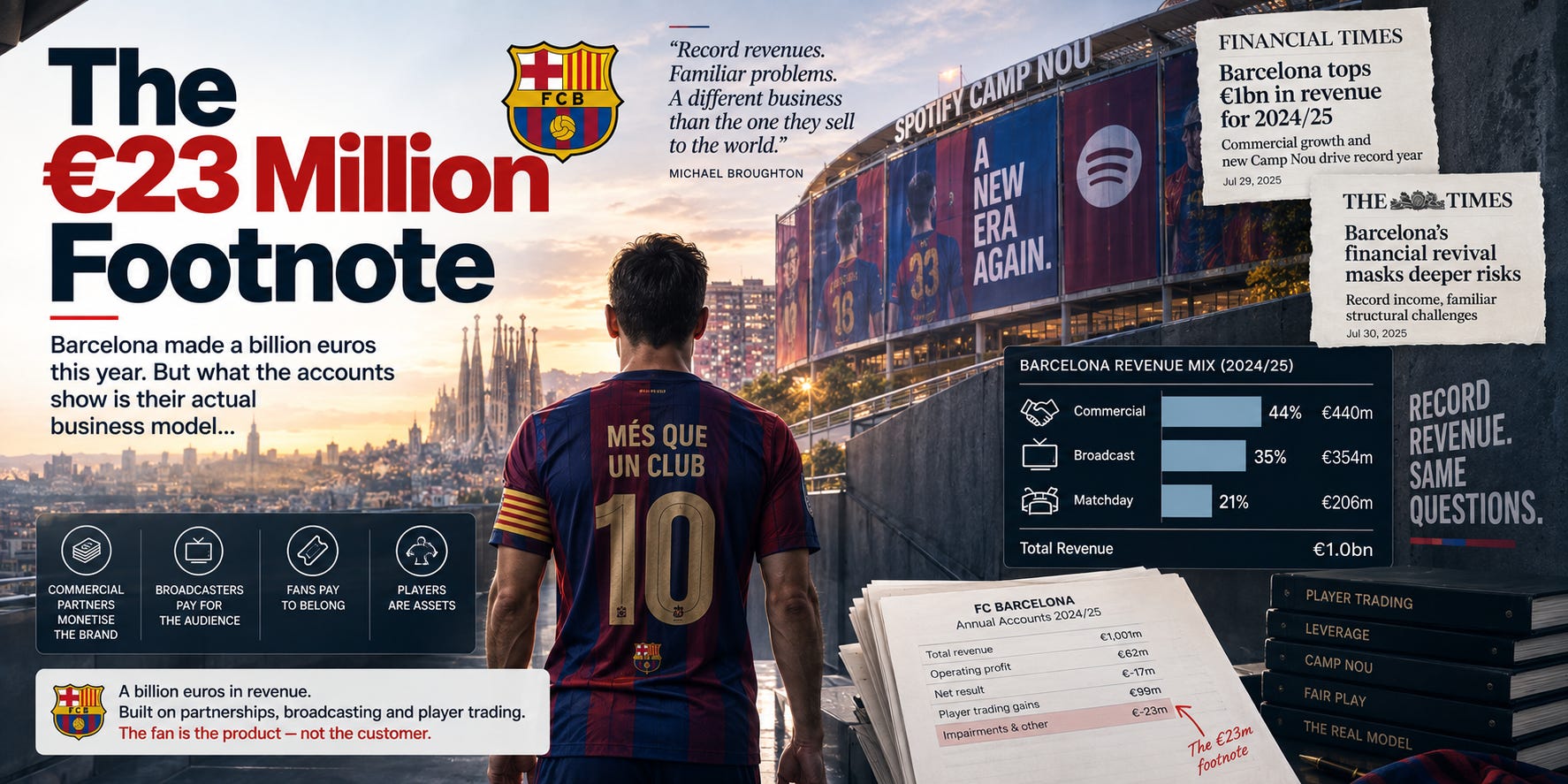
The club crossed €1bn of operating revenue for the first time in its history. A landmark, and the coverage rightly reflected it. In the same accounts it posted a net loss of €18m, and hidden in there as well was a €23m impairment against Barça Produccions, the vehicle holding the club’s audiovisual and digital business.
What the levers actually bought
The background, for anyone who wasn’t watching. Summer of 2022, Barcelona sold 24.5% of Barça Studios to Socios for €100m, then another 24.5% to Jaume Roures’ Orpheus Media for the same money. A €400m valuation on a content business that wasn’t profitable – and was a mirage. In 2023, Libero Football Finance and investors advised by Nipa Capital took 29.5% of Bridgeburg Invest, the holding company behind what had become Barça Vision, for €120m. That August the club agreed a de-SPAC with Mountain & Co that would have listed “Barça Media” on Nasdaq at around $1bn. It was madness that they wanted to list this small media company that really had no actual assets…but it was the height of the SPAC craze and helped justify some internal projections.
The SPAC was terminated in June 2024, with the minimum cash condition renegotiated down from $50m to $40m on the way and a revenue condition the parties couldn’t meet. Barcelona folded Bridgeburg into Barça Produccions and wrote it down. This year they wrote it down again. Reported cumulative decline is now around €116m, the club’s stake has risen to 63.14% — largely because it cancelled debt owed by a partner who hadn’t paid — and that controlling stake is carried at roughly €73m.
Park the valuation argument for now. The structural fact is harder to wriggle out of. An asset four separate sets of investors were willing to price between €400m and a billion dollars – but whom each at different times balked at, has spent four years failing to generate the revenue that would justify any of it. That SPAC didn’t fall over on sentiment. There was a revenue condition and they couldn’t hit it.
BUT as the €1bn in revenue has shown, just because the media company has failed in its own right, it doesn’t mean the content it created didn’t have a purpose.
Now look at what did work
I have often stood on stage arguing that sports teams are not Media Companies, and have run Masterclasses at World Football Summit teaching the same things. They are actually…Sponsorship, Licensing and Ticketing Companies (I would argue that those that are listed on exchanges tend to trade on those valuations).
So lets look at what the accounts say. Operating revenue €1.06bn, up €66m. Sponsorship €265m, a club record. Barça Licensing & Merchandising €208m, up €40m in a year on a global e-commerce rollout. Matchday recovering as they move back into Camp Nou, with next year’s budget assuming €60m of stadium uplift from a full season at home.
Sponsorship plus licensing is €473m. Getting on for half the club’s revenue, and growing. The media company is an impairment line.
That isn’t a Barcelona quirk. That’s the football business model, written down in audited accounts by people with no incentive whatsoever to make my argument for me.
The Manchester United control test
Barcelona is a members’ club with idiosyncratic accounting and a president who has to get re-elected. For an investor we can perhaps get a cleaner read elsewhere and use the club that files with the SEC…my favourite battering ram.
Manchester United, fiscal 2025, to 30 June: record revenue of £666.5m. Commercial £333.3m, half the business. Broadcasting £172.9m, 25.9%. Matchday £160.3m, 24.1%.
Two things in there matter more than the headline.
First, broadcasting fell 22%. Not because the content underperformed but because the men’s first team finished 15th in the Premier League and played Europa League instead of Champions League. That’s a key point to consider as a media company’s revenue moves with audience, subscriptions, ad rates, renewals. United’s broadcasting revenue moved with the league table. That is not media revenue. It’s a share of somebody else’s media revenue, handed out on sporting merit — a royalty on a rights sale the club doesn’t own, can’t package and can’t price because its (rightly in my opinion) collectively bargained.
Second, in the worst league season most United fans can remember, commercial revenue went up 10% to a record — sponsorship up 6% on the first Snapdragon year, retail and licensing up 15.8% on a new e-commerce model. The stable, growing half of the business is the half that sells the badge.
And then the bit nobody likes to mention. United owns MUTV — its own filings call it a wholly owned global television channel delivering United programming around the world. Yet in fourteen years as a listed company it has never been material enough to be a reportable revenue line. If this media business were the central pillar, the CFO would be disclosing it. But the reality is, as with Barca, the internal media house has an actually critical function but its not about media…it’s about driving content to support what they can control – sponsorship, licensing and ticketing!
So who are the actual media companies?
The Premier League sold its domestic rights for 2025-26 to 2028-29 for £6.7bn, about £1.675bn a season, to Sky, TNT (HBO now) and the BBC. The league owns and packages the rights. Sky and TNT produce, schedule, market, distribute and carry the subscriber risk. Media businesses on both sides of the coin.
The club’s job in the chain is to supply the raw material and take a share of the revenue. A critical supplier — obviously without the twenty clubs in the league, there is no product — but a supplier is not a studio.
Barcelona made the point more brutally than I ever could. The club had exactly one genuine media asset: its future share of LaLiga television rights. It sold 25% of it, for 25 years, to Sixth Street, for €667m. So, it sold its media asset and then capitalised the content department. Then – predictably - wrote the content department down, because it’s a support function and more accurately positioned as a marketing cost. If you actually believed you were a media company you’d have done the opposite.
Content as Catalyst
This is where people usually hear the lazy version of my argument, so let me be clear. I’m not saying stop making content. I’m saying make more of it, and make it better, but understand what is your business model as pretending to be something you are not is wasting energy.
I’ve been banging on for years that content is the catalyst, not the king. It’s the stimulus for something else — the conversation, the sharing, the emulation and eventually the transaction. What drives me slightly potty is watching clubs make the content, push it out, and stop there. That’s a web 1.0 mindset using web 2.0 tools, and at that point you’ve built a cost centre and told yourself it’s a profit centre.
Used properly, content is the cost of goods sold for the sponsorship and licensing business. It’s inventory creation. It’s what turns an abstract “1.1 billion fans and followers” into something a partner can be sold access to and a licensing programme can be launched into across 170 countries.
And it works. United grew commercial revenue 10% in a fifteenth-place season. Barcelona’s merchandising grew 55% one year and another €40m the next. That’s content doing its job. The return is real — it’s just booked in a different column.
And if you want to be one anyway
Fine. Here’s the invoice.
It’s capital-intensive, and the capital goes in years before anything comes back out. Production infrastructure, commissioning budgets, distribution deals, rights acquisition, and the bit clubs always underestimate — people. Editors, commissioners, producers, ad sales, churn analysts. Hired in numbers, paid at media rates, kept through the seasons when the first team finishes fifteenth.
And you can’t build it on matchday, because matchday is already sold. The league sold it collectively, four years at a time, to the broadcasters who paid £6.7bn. What’s left to you is the surrounding material —the inventory that you currently use to make the sponsorship business work. You’ve spent nine figures to arrive back where you started.
Which brings me to the part I hold as judgement rather than fact, from twenty-five years in the room rather than anybody’s accounts. Outside of stadium projects, clubs are instrinsically hostile to capital-intensive investment unless the capital is going into players. A £60m centre back gets signed inside a fortnight. A £60m five-year content build gets pushed to the next budget cycle (I’m joking it will never get looked at properly), then the one after, then quietly resized. Players have a transfer market, a resale value and a fan base willing to march for them. Studios have a depreciation schedule. It needs a very different mindset – or setting up a separate legal entity likely in partnership with an actual production/media house.
Reimagine your model
One thing I do think is really interesting is that given all the tech that exists today and the creator economy and the ability to scale differently is this.
Keep building out your content capability. Let it continue to feed your current model…sponsorship/licensing/ticketing, but also flip the switch. What if the fan actually came first – not the sponsor (and every fan knows the sponsors comes first currently, its not even hidden anymore).
Now start to use the content to build community and interaction and drive the conversation, which is a 2 way interaction that takes place everyday just outside the clubs eco-system. Take a look at companies like Horizm and map out if you actually sold inventory to your content like a media company, what could it do?
Not every change has to be drastic or costly. A mental shift will help significantly.
BUT it can only happen if today you understand the business you are in and what you want to be, don’t mistake your COGS line for your actual business.
The translation
Barcelona’s billion is not a vindication of the club-as-media-company thesis. It’s a vindication of the sponsorship, licensing and ticketing thesis — achieved despite the media company, with €23m of tuition paid this year for the distinction.
Make the content. Make more of it, make it better, and put proper people on it. Measure it in incremental sponsorship value, renewal rates and merchandise conversion.
Just don’t put a multiple on it.
The most interesting line in here is the "fan is the product, not the customer" nice read Mike!
Another interesting and thought-provoking piece, Michael.
I wish that more clubs understood how beneficial building content capacity could improve their commercial revenue, brand equity and valuations, which almost sounds as an oxymoron in a (supposedly) more disciplined environement following the proliferation of new capital/investors.
In FC Barcelona's case, especially with its current President and some of the current cashflow challenges, any revenue stream with potential seems likely to be securitized.
Some would argue that their revenue increases tend to be looked at as potential loopholes to avoid Financial Fair Play fines.